
My Last Post Almost Killed Me
This is why proper sourcing is important, people

In my recent post about Russian Princess Catherine Dashkova, I went through several episodes of her remarkable life. One thing I left out, though, was the time she fought a duel with another woman.
I know! How could I neglect this detail? This would surely have to be the most exciting anecdote involving her. The post went through several drafts of a section including this duel, but I ultimately cut it entirely. There was a problem:
I don’t think it ever happened.
I first became aware of this story when skimming through her Wikipedia article.1 It suggests simply that she was “wounded in a sword duel with another lady” while living in Edinburgh, where her son was attending school.

This story didn’t strike me as implausible. Dashkova was stubborn as all hell, and could have a fiery temper when she felt insulted, which was rather often. Much of her life was spent in spheres 18th century society reserved for men— science, philosophy, politics— and many contemporary accounts of her write of her as more man than woman. Sometimes this is meant in a complementary way, sometimes not. Regardless, it lends itself to the conclusion that it would not be all that strange for her of all 18th century Russian women to be involved with a duel.
An obligatory comparison for me to make here would be to Julie d’Aubigny. This 17th century Frenchwoman also led a remarkable life where her accomplishments and feats can easily bleed into legend. We know that she was a gifted fencer, and fought and won many duels over the course of her short life. Did she really defeat three men in one night, after stealing a woman at a ball and insulting them all, as her most famous story goes? Maybe not.2 But d’Aubigny’s story led me to take Dashkova’s at face value.
I started to look into Dashkova’s duel legend. There are a few places online which mention it, though very sparingly. The most detailed readily available account of her duel comes from Pictolic, which writes:
In 1770, a not very pleasant story happened to Princess Ekaterina Dashkova. It happened in London, in the house of Countess Pushkin, the wife of the Russian ambassador. The Duchess of Foxon, who was considered one of the most educated women in England, came to visit the countess. The reason for her arrival was a desire to talk to Dashkova, and if possible, to discuss with her. After half an hour of conversation, a heated argument ensued between the ladies. The rivals were worthy of each other, so the situation quickly escalated.
This version of events differs in several respects from the one on Wikipedia. This places the action in London, not Edinburgh, and in 1770, not 1779. This would put the princess at 27, before she had met Ben Franklin and Voltaire and Denis Diderot, and perhaps still more youthfully bellicose. I later discovered the article to be a rough copy/paste translation from a post made on VK, a Russian social media site, which would account for some odd sentence constructions. (“A not very pleasant story happened…” “The rivals were worthy of each other…”)
Other places online corroborate this version of events. The super official and academic sounding, but equally Russian Big News Network writes a very similar account to the one at Pictolic:
However, even abroad, Russian ladies didn't part with their fiery tempers. In 1770, the director of the Imperial Academy of Sciences and the Arts, Princess Catherine Vorontsova-Dashkova, really got into it with Duchess Foxon in London. Initially, their meeting at the salon of Countess Pushkina, the Russian ambassador's wife, was going smoothly, but, at some point, the conversation escalated in tone, one word led to another and Dashkova challenged Foxon to a fight. The two crossed swords, with the duchess emerging victorious after wounding her opponent.
If you’ve read my initial post on Dashkova, you may be able to catch at least one thing wrong with this snippet: Dashkova was not made director of the Academy until much later. In 1770, Dashkova would have been a minor noblewoman who had been cast out of Catherine’s court for claiming too much responsibility for the revolution which had installed her as Empress. It’s also worded so similarly to the previous post that I began to wonder:
…Are all these places just circuitously referencing each other?
There are no sources given in these various articles. Massie’s biography of Catherine the Great, which had been the place where I’d first encountered Princess Dashkova, made no mention of her ever fighting a duel. Scholarly, peer-reviewed JSTOR articles on Dashkova do not mention it. I found collections of letters written to and by Dashkova— certainly only a fraction of the existing ones— but none refer to any duel.
Eventually, I decided to check the Princess’s own memoirs.
This proved a whole adventure of its own. Her memoirs are available in print, both in the original French and English translations, and I do plan on reading the entire thing at some point, but my TBR is terribly long as-is and I wasn’t about to purchase and read her entire memoir just to fact-check something for all two of my subscribers.3 So I wanted to find an online pdf and just do a crude, brute-force ctrl-F. But it was remarkably hard to find a pdf of this public domain book…
After waiting an hour for a pdf to download, and then telling me it has in fact failed to download, I went to the internet’s greatest resource, the Internet Archive, and questioned why it took me so long to go here in the first place; I found a copy of her Memoirs in one search. I searched for “duel” and…

Yeah.
But okay, perhaps she speaks in euphemism. She could have written something like “a most peculiar incident” or “an argument solved in the ways of d’Artagnan” or whatever poetic alternative you can think of, in lieu of saying the d-word itself. So I read the sections describing the times in her life when the internet claims she fought this duel.
The Wikipedia article— the one claiming the duel happened in 1779 in Edinburgh— is the only place that gave a proper citation on this story, and gives its source as the same edition of her memoirs that I found on the archive. The cited page does indeed feature Dashkova writing about her time in Edinburgh, but it’s all happy memories and she does not make any mention of a potential rival.
What about London, then?
When I arrived in London I found that our Minister, Mr. Pushkin, had already prepared a house for me in a part of town near his. His wife (she was his first) was, I discovered, the pleasantest and most estimable woman one could wish for a friend, and she quickly became mine.
Well… that’s… not exactly a duel, either. She makes no mention of the Duchess Foxon with whom she allegedly fought. Per the Memoirs, her London stay was happy and short.
I suppose it’s possible this event happened, and she chose not to write about it. Perhaps her reputation as a dangerous woman— accusations of being involved in Peter III’s death4 followed her her whole life— discouraged her from writing about it, for fear of stoking more controversy. But Catherine the Great’s time on the Russian throne is often seen as existing at a time where duels in Russia, particularly women, were somewhat common. The same aforesaid websites often mentioned that Catherine served as a second in 20 duels in her reign. (But at this point, I’m not sure I can take anything they say as anything but pop history.)
I also think, given her personality and approach to controversy, it would not have been in the Princess’s modus operandi to simply ignore such a story, if it existed. She met charges head on, writing letters and running around town boasting her best one-liners to all who would listen. The potential controversy contained in the Memoir led its publication to be delayed several years after Dashkova’s death, and were written at a time when her reputation had fallen into decline. If a story existed at the time of Dashkova fighting a duel, it seems as though it would have been something she would have wanted to address in her own memoir.
So I’m pretty sure this story is a modern bit of urban legend. If it was real, Dashkova surely would have boasted about it in her memoir. If it was a contemporary rumor, she would have addressed it. I can not find any reference to it beyond modern, unsourced and informal articles online. But how did this story get started in the first place?
I have a kind of crazy theory.
Meet Pauline von Metternich:
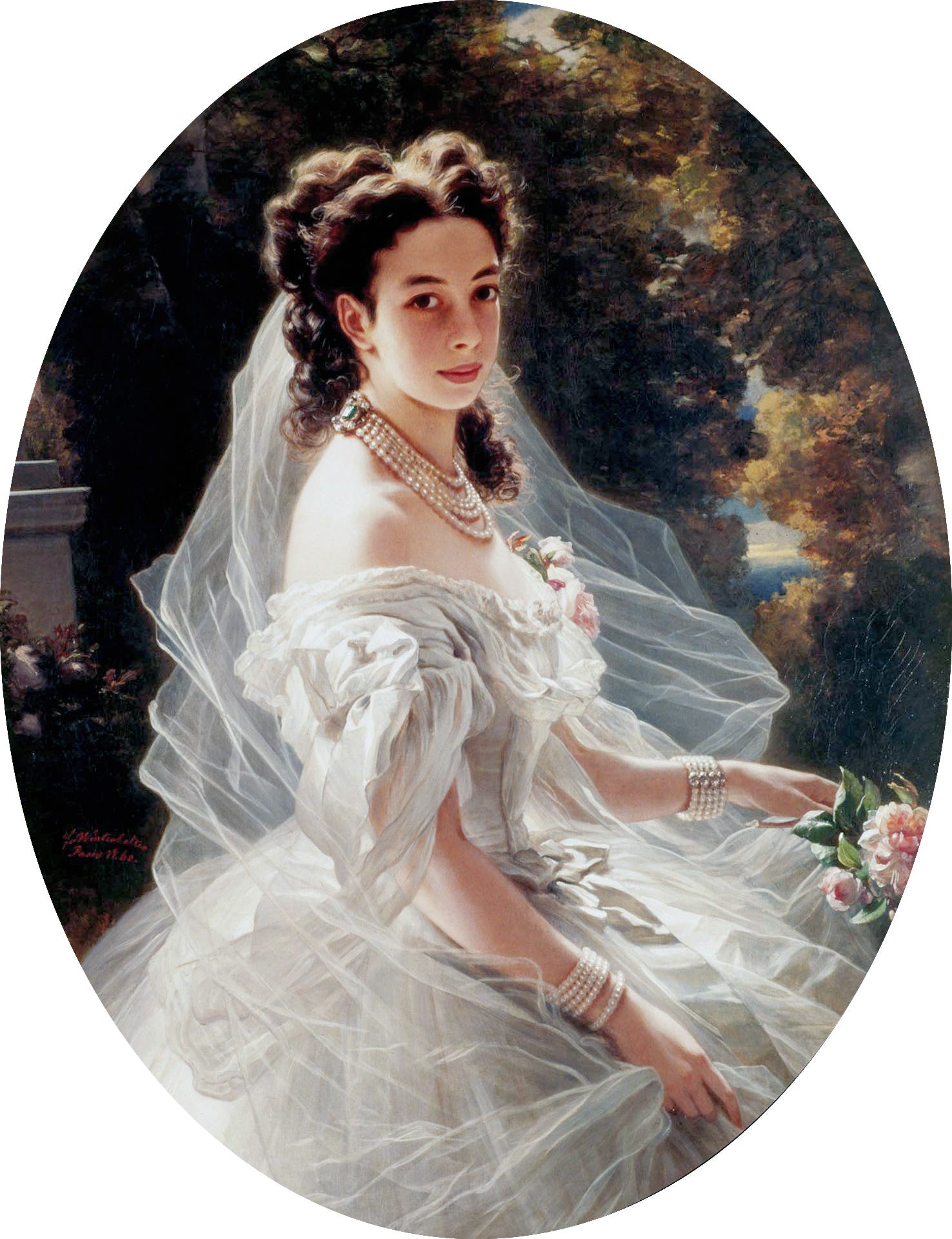
Granddaughter of Klemens von Metternich of Concert of Europe fame, and wife of the Austrian ambassador to Napoleon III’s France, Pauline’s life shares some similarities with Dashkova’s. Both were European princesses with an impressive amount of impressive friends. Both were interested in typically masculine spheres— political philosophy and sciences for Dashkova, and cigars and skating for Pauline.
Both are also alleged to have fought a duel.
The story of Pauline von Metternich’s duel goes something like this:
Pauline, who took great joy in choreographing social events, took issue with a comment from Countess Anastasia von Kielsmanegg, a Russian-born noblewoman married to an Austrian diplomat. Anastasia supposedly criticized a particular flower arrangement done by Pauline at the Vienna opera house, and this criticism escalated into an argument the two women could only resolve through a duel.
The duel took place near Liechtenstein, and featured two other women as seconds as well as a female Polish surgeon on hand. This surgeon, an early proponent of germ theory, told the Princess and Countess to remove their clothing from the waist up, fearing layers of clothing would increase the risk of infection, leading to the most famous, and scandalous, detail of the encounter— that it was fought with both women topless.
Countess Anastasia wounded the Princess on the nose, and the Princess landed a blow on the Countess’s forearm— two minor wounds which nevertheless caused the seconds to faint, and render the outcome of the duel in some ambiguity. When the seconds came to, they made the women kiss and make up.
There are more details available on this event than Dashkova’s. It was known at the time, and Pauline denounced it as “a ridiculous invention by Italian journalists.” But, like Dashkova’s, it likely never happened. Or at least, not in the way typically described.
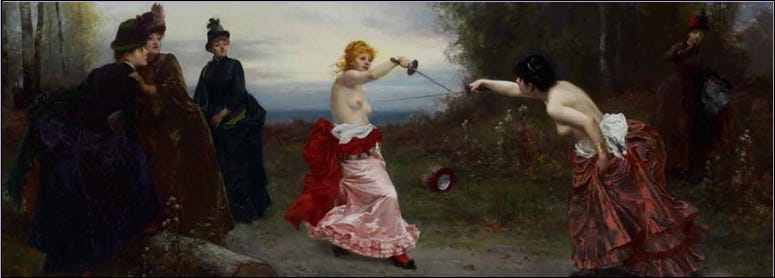
The painting above, painted by Emile Bayard, most known for illustrating young Cosette in Les Miserables, is often considered to portray Pauline’s duel with Countess Anastasia. However, it predates the duel story by ten years. And the topless aspect, which the painting includes, is absent from contemporary descriptions of the encounter, which imply the women fought in sheer, thin undergarments. If the duel did happen, the topless element is fiction imitating art. It’s a likely conflation of the newspaper reports and the painting’s own scene— in other words, a 19th century Mandela effect.
So, here’s my theory: Perhaps this is where Dashkova’s duel story originates?
There are many similarities between the two stories. Dashkova and Pauline are both princesses of famous 19th century houses. Both were known in their day as breaking gender norms and have been rumored to be bisexual by modern readers. Both involve a Russian-born noblewoman living abroad. Both involve the wife of an ambassador.
The cultural obsession with the idea of a sword duel in Europe reached a literary peak in the late nineteenth century, a few decades after Dashkova’s memoirs were finally published. What if her memoirs, written in large part to reclaim her place in popular memory after Catherine’s successors downplayed her accomplishments, did succeed in making her name more well-known? Perhaps decades of readers eager for scandalous European women’s exploits came to mix the stories of Dashkova and Pauline von Metternich together, and so Pauline’s duel story has come to be recast with figures from Dashkova’s life.
Perhaps that’s a little bit crazy. But I can promise you one thing:
I will actually go insane if I stay down this rabbit hole any longer.
Sorry!
For more on Princess Dashkova’s life, check out this talk at the Royal Irish Academy.
For more on Pauline von Metternich’s alleged duel, this podcast will fill you in on a lot more.
I’m not entirely sure what the greater Substack community’s thoughts on Wikipedia as a source/research tool are, but I view it as an excellent starting point, personally.
This is a mental note to self to look into this and write a post on Julie if I can find enough concrete information
I also want to read the original French, which I can do but will take me quite a bit longer than the translated versions.
She was involved in his overthrow, but not his murder.